


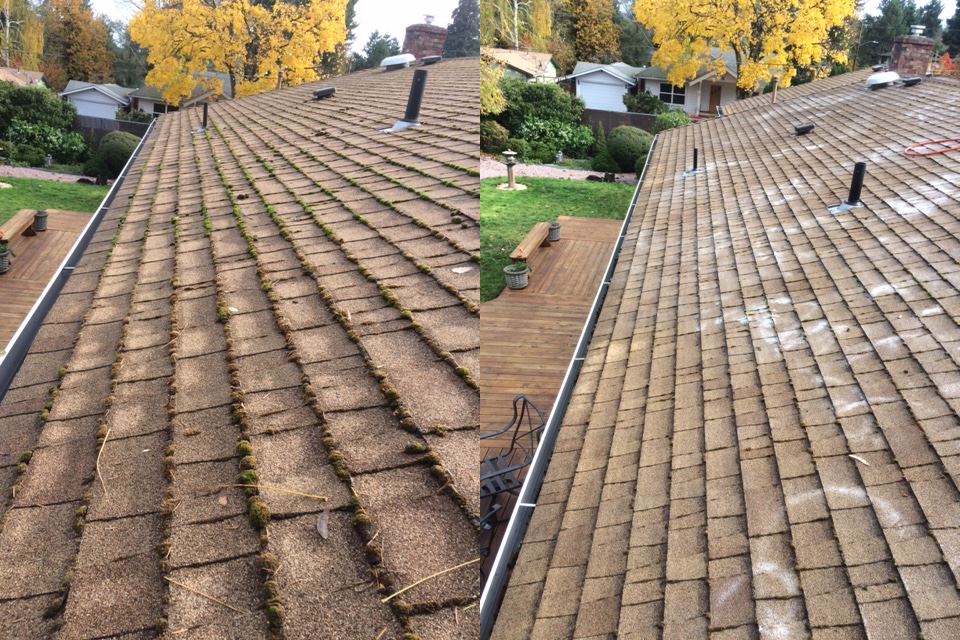
People ask us this more than almost anything else: do you pressure wash the roof, or brush it? The honest answer is "it depends," and it's not a dodge — the right method for a given roof depends on the moss, the shingle, and how much of a hurry you're in. Most Portland roofs get one method almost exclusively, a few need a second one layered in, and some roofs are actually better off getting neither, at least not all at once.
Two methods, one goal
We use a hand brush on the large majority of roofs. It's physical, it's controlled, and it does the job without introducing water pressure to shingles that don't need it. The rest get a low-pressure wash — not the rental-grade blast you're picturing, but a gentle, high-volume flow that lifts what a brush can't. Which one we reach for depends on what's actually growing up there and what shape the roof is in, not on which piece of equipment is faster to run.
"I have my water pressure down to low PSI so it won't harm your roof whatsoever. I can put my hand in front of it as it cleans with mostly water volume."
— Jesse Rice, Owner, JNR Industries
That's the test we hold ourselves to. If a technique would tear up granules or strip a shingle's protective coating, it isn't part of the job, full stop — whether that's a brush pressed too hard or a washer turned up too high.
Why hand brushing is the default
A brush removes moss the way it actually grows: rooted into the shingle surface, one course at a time. It doesn't introduce water pressure at all, so there's no question of granule loss or a shingle edge lifting under a stream. For the vast majority of Portland composition roofs, that's the safer, more controlled option — and it's why it's our default rather than the exception.
When low pressure is the safer call
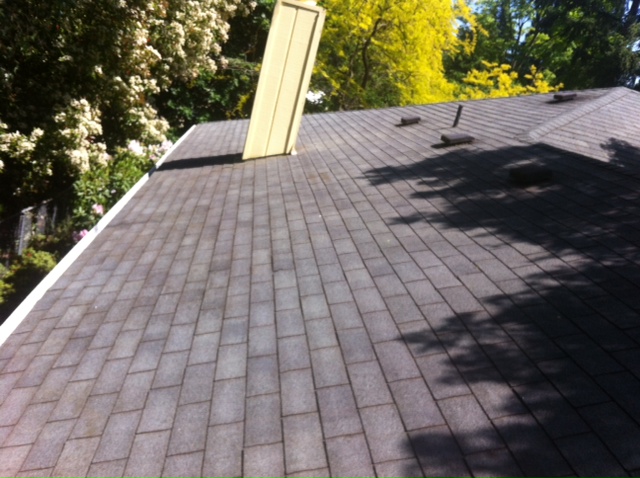
Brushing alone won't lift everything. Black mold and algae staining sit differently on a shingle than moss does — they discolor the surface rather than rooting into it — and a brush just moves them around instead of removing them. On roofs like that, or on certain moss types that have gone thick and matted, water volume does what bristles can't. We keep that pressure low enough that Jesse can hold his hand in front of the nozzle while it's running, which is the plain test for whether it's cleaning the roof or damaging it. Pressure washing has a bad reputation in this business because of contractors who don't run it that way — a high-pressure blast strips granules and shortens the life of the shingle underneath it, and we won't do that to a roof regardless of how much faster it would make the job.
In short, what decides the method on a given roof:
- Moss type and thickness — thin, newly established moss usually brushes off clean; thick, matted growth sometimes needs water volume to loosen first.
- Black mold or algae staining — a brush won't lift it; a gentle low-pressure wash will.
- Shingle age and condition — older, more brittle shingles get the gentlest method that will still do the job.
- How much is on the roof — a roof that's gone years without treatment sometimes needs both methods used together in one visit.
The no-touch, gradual approach
There's a third option we use on some roofs: nothing at all, at least not right away. We have a long-term maintenance approach that's genuinely no-touch — no brush, no washer — that relies on regular treatment applications and air blowing dead moss loose over time. Most of the moss comes off within a year to a year and a half using this method. It's slower, but it's the gentlest thing we can do to a roof, and for shingles that are getting older or a homeowner who isn't in a rush, it's often the right call. Every roof tells its own story, and part of our job is figuring out which method that story calls for — not defaulting to whichever one is fastest for us.
What we never do
Regardless of which method a roof needs, there's a line we don't cross: a high-pressure blast. That's the technique that's given roof pressure washing a bad name in general — granules stripped off in a season's worth of shingle life, gone in an afternoon. If a company is quoting you a fast, cheap wash with a rental-grade pressure washer, ask them directly what PSI they're running and whether they can put a hand in front of the nozzle while it's on. If they can't answer that, that's your answer.
If you're not sure which method your roof actually needs, our roof cleaning & eco-friendly moss treatment page covers the full process end to end, and the roof maintenance plan explains how the gradual, annual approach fits into keeping a roof clean long-term.
Frequently Asked Questions
Do you pressure wash roofs, or is that safe for my shingles?
Will I see results right away, or does the treatment take time to work?
How often should I get my roof treated to keep moss from coming back?
Is the treatment safe for my plants and pets?
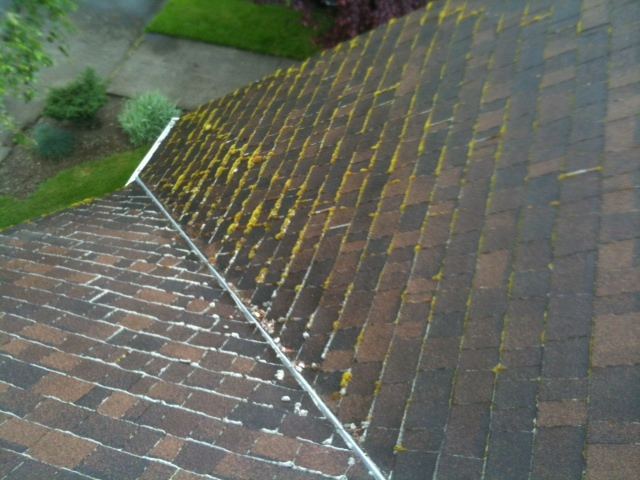
Every roof tells its own story — how old the shingles are, what kind of moss is up there, how much shade it gets — and that story is what decides whether we brush it, wash it gently, or just let treatment do the slow work over a season. If you're not sure which one your roof needs, send me a photo and I'll tell you straight.
— Jesse